Sunday, September 4, 2011

Trashy Jobs

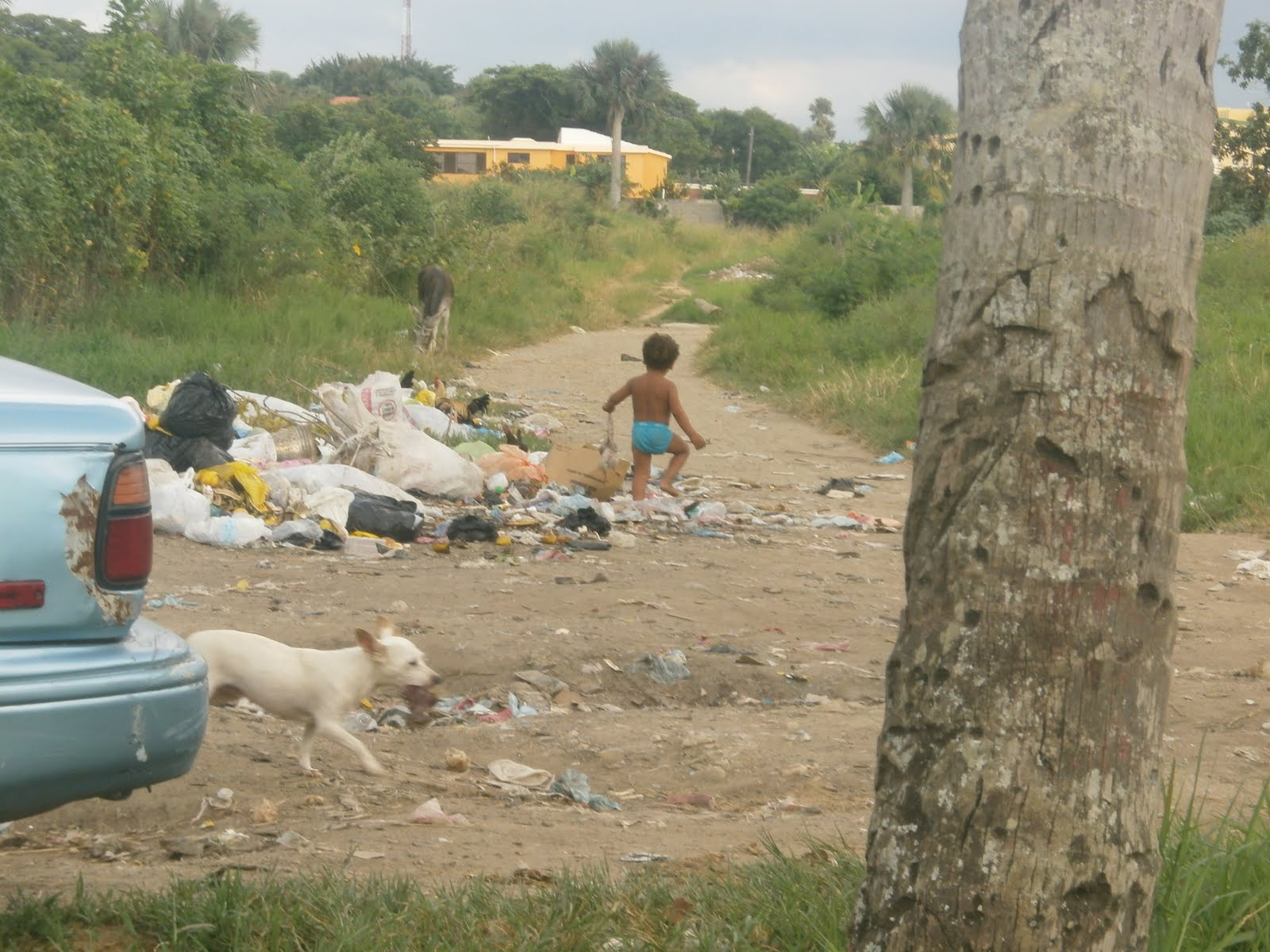
Santa Lucia is a barrio or neighborhood in the northwestern sector of Santiago, Dominican Republic. In many ways, it could be one of many barrios in the Caribbean nation. To a North American, of course, it seems to be woefully under developed; with a clay road which can be traversed only slowly, and housing made largely of stacked concrete blocks with tin roofs and few modern conveniences. But in a nation where 40% of the population lives in a situation of poverty, these conditions are hardly exceptional.
What does set Santa Lucia apart, however, is the giant landfill that dominates the “skyline” of the community, and the consequent lifestyle that has sprung up around it: that of the “buzos.” Buzos are individuals who make their living by digging through human trash, usually in order to find valuable items that can then be sold. The effects that this “profession” has on the already delicate public health of the region are deplorable; not only to the buzos themselves, who can, and do, pick up diseases while on the job, but also to the surrounding community.
Although difficult to quantify, the physiological effects of the buzos are equally damaging to the community. Elizabeth from the organization “Niños Con Un Esperanza (NCUE)” translated “children with hope” notes  (paraphrased from the original Spanish) “Children who grow up as buzos are extremely difficult to integrate back into regular society. It stays with them.” Elizabeth continued, saying “People of all ages usually get involved in buzo activity because they must. The high unemployment and lack of economic activity often leaves people with no other option than life as a buzo.”
In order to combat this alarming phenomenon, NCUE has proposed an ambitious program called “Reciclado de Deseclas Plasticos en el Sector de Santa Lucia” (Spanish for “recycling of the abandoned plastic in the Santa Lucia sector). This program would construct an easily accessible plastic recycling center within the community. The recycling center would be overseen and operated by NCUE and staffed by 20 people selected from the community. For Santa Lucia, this program would not only slightly ease the high unemployment by creating jobs for 20 community members, but also mean cleaner streets because it would provide buzos with the incentive to collect plastic. In addition, since plastic is a relatively safe material to handle, the buzos themselves would benefit because there would be less need for them pursue more dangerous material such as glass or metal. Perhaps most importantly, however, once the recycling center is able to become profitable, the  extra income would go to NCUE, which could then afford to take more children off the streets and away from the buzo life style. NCUE is currently applying for the prestigious ping grant to fund this community project. With this program we hope to improve the community by providing opportunities for dignified work,” says Elizabeth. “This directly benefits Santa Lucia with increased economic opportunities.”
Of course, no one program can solve a problem as pervasive and deleterious as that of the buzos overnight. However, organizations that persistently work on several fronts to remedy the situation can begin to make a difference. NCUE, for one, is currently working with over 200 children and providing them with a structured learning environment, life skills, and, in some cases, a first taste of human compassion. The program “Reciclado” would expand and augment this process by addressing the buzo issue more directly and providing alternative means of income for community members. Although small, this program would be a step towards a better life for many, and in a community like Santa Lucia, that is not to be ignored. “If nothing else” says Elizabeth, “we would like to provide the community with hope.”   
   -Joseph Strzempko 

Sunday, August 28, 2011

The Vacation Ends


I’d like to start out this post by making a general announcement to my friends and relatives on the east coast that: yes, I am fine. Irene didn’t even come through here. In fact it’s you guys who should be worried about the hurricane.
That said, my second week here has been both amazing and exhausting. Having been properly coddled and pampered our first week to prevent the onset of a too severe case of culture shock, on Tuesday, we finally got down to the serious business of community service. Being enrolled in the program Santiago Service Learning, service is, after all, the whole reason that we’re here. Therefore, we are required to volunteer at some organization for the semester. To this end, we spent the week touring various organizations so that each of us could find somewhere to work.
 Tuesday was devoted exclusively to the hospital and affiliated health organizations of Juan XIII http://centrojui. At Juan XIII, we spent the morning inspecting the hospital portion of the organization. The hospital itself was well-maintained, well run, and seemed all together quite efficient.  Still, from the crowded waiting rooms and harried looking staff, it was obvious that they did not have the recourses to meet the insatiable demand imposed upon them by the surrounding community. That afternoon, we went to another Juan XIII owned organization, named “Cambodia” (not sure why), which was a whole neighborhood devoted exclusively to people suffering from hypertension and asthma. The community was staffed by several medical personal that did daily rounds around the neighborhood to check up on all the patients. We got to follow a pair of them around their rout to get a good idea of what working for this organization would be like. The sight of the run down, poverty stricken, barrio that these people call home was disquieting, and the sight of a women’s bulging, diabetes ravaged, leg was heart breaking. But everyone we visited was so polite and infectiously optimistic that it was hard not to be cheerful with them.
On Wednesday, we visited Arte a Mano, an organization designed to support local artists and artisans in order to both contribute to the cultural richness of the region and to grow the local economy. Art, alas, has never been a strong suit of mine; so I was skeptical from the get go. What did it for me, however, was being assigned to help transport some of the works. Because of my inherent clumsiness, I found carrying expensive, pain stakingly prepared, and extremely delicate pieces of art around the city of Santiago to be a terrifying experience. Accion Callejara http://ong.tupatrocinio.com/accion-callejera-fundacion-educativa-inc-ong-665.html, another organization we visited on Wednesday, I found to be a little more to my taste. It is essentially an after school program/homeless shelter (depending on the need of the person in question) for the youth of the surrounding community.  It especially focuses on children who live on the street, by taking them in and working to reintegrate them into society as well as provide them with an education.
On Friday, we visited the final organization, One Respe http://www.onerespe.com/  (creol [the language of Haiti] for “Honor and Respect”). This organization works to provide Haitians and Haitian (I.E. dark skinned)–Dominicans living in the Dominican Republic with wider opportunities for participation in society; a process which is made difficult by the racist attitudes of some across the nation.
When all is said and done, I have to say that I would be happy and proud to work for any one of these organizations (even Arte a Mano which, after all, has a very noble mission). At the moment, I find myself leaning towards either Accion Callajera or One Respe, because my polisci background is good for the sort the sort of clerical paper pushing that both of them want out of volunteers. But again, who knows? Maybe I’ll have a sudden change of heart tonight and decide art is my thing after all. Either way, I’m very exited by my potential prospects and look forward to getting to know my future service program, whatever it may be.             

Monday, August 22, 2011

D-Day +7


One week ago on Monday August the 15th 3 Clark Students; Nara Baker, Molly Cooksey, Natalia Salazar, and myself departed from the U.S. for the Dominican Republic. From the very beginning our journey was rife with perils. A series of flight delays and cancelations caused Nara to miss the majority of the first day and forced Natalia to sleep in the Miami airport. Molly and I were able to make all of our flights on time, however, because of a mix up in the Miami Airport, our checked luggage got lost and we were both left to make due with our carry -on’s for the first several days.
Fortunately, the lack of the essentials I had packed was more than made up for by the accommodation and compassion of my host family. My host family is made up of my host mother, Rafaela and her husband, Victor. They were nice enough to provide me with everything I might need, and accommodating enough to put up with all of my shortcomings; from my all-together poor command of the Spanish language to my seemingly irredeemable klutziness which resulted, among other things, in my hand being caught in the ceiling fan (in fairness it was a very low ceiling fan, sometimes I feel I’m just too tall for this country…sigh).
So far the Dominican seems to me to be a country of extremes. In this last week I’ve seen sparkling brilliant-blue rivers and waterfalls deep in the middle of a lush and pristine jungle, but also, while jogging in downtown Santiago, almost fallen into an open sewer festering with trash, insects, rats, and human filth. I’ve climbed to the top of El Monumento de Santiago, a breathtaking tower thrusting violently into the sky, dominating the city of Santiago (constructed during the dictatorship of Rafael Trujillo, supposedly to celebrate his extensive, ahem, machismo), only to walk back down to find pathetic hovels made of wood and tin. And, of course, I’ve seen the startling opulence of the wealthy class of the nation with gorgeous and well-dressed Dominican caballeros and damas burning holes in the dance floors of the dicotecas (clubs) on weeknights till four in the morning when they call taxi’s to return them to their palacios (mansions).  From the door to the taxi, each one haughtily ignores the army of beggars who approach them dressed in rags with drawn, thin, and dirty faces devoid expectation or hope.
To be sure, I’m having an awesome time. From the nightlife, to the other people in the program, to my host family, I can say with certainty that I’m really lucky to be in the program Santiago Service Learning and to have this unique opportunity. I look forward to great experiences and a couple of hard lessons (hopefully not as painful as getting my hand caught in the fan tho) as I get to know the Dominican Republic.

Saturday, August 13, 2011

Pre-Departure

My name is Joseph Strzempko, and this is the first post of my blog, "A Semester in Santiago with Joseph Strzempko." In two days, I will leave my parents house in Westfield, Massachusetts for Santiago, Dominican Republic to participate in the program Santiago Service Learning with CIEE for the upcoming fall semester. This blog will be used to chronicle my experience in the Dominican Republic, both by examining my academic experience and how it relates to classes I have taken at Clark University (Worcester MA), and by recounting specific episodes (and misadventures) that I feel might best give an organic account of my time abroad.  
 I would like to start off by telling a little bit about myself and explaining why I chose to participate in Santiago Service Learning. I am currently enrolled at Clark University http://www.clarku.edu/
 and will be a Junior this upcoming semester. I am majoring in political science http://www.clarku.edu/departments/politicalscience/ and minoring in Spanish http://www.clarku.edu/departments/foreign/. Knowing full well that a semester abroad is often a synonym for 4 months of academic mediocrity, when weighing my options for the upcoming fall, I wanted to ensure my time abroad would leave me collegically as well as personally enriched. Both of these I think I have found in Santiago Service Learning which offers classes which focus both on Spanish language comprehension and topics with a polisci orientation: all of which are taught at La Universidad Pontificia Catolica de Madre y Maestra in Santiago. Aside from academic concerns, of course, I wanted to do something with my semester that I felt would be really fulfilling. Here, again, I think I'm lucky as the program I am in is heavily focused on community service and will take me across the countryside and into Haiti doing service work.  
So thats where I stand right now. To be honest I have no idea what to expect exactly. At the moment my worries range from the very real prospect of being mugged or catching malaria to less practical concerns such as whether or not I'll look douchy if I make my profile picture a photo of me helping build a village  or speculation as to if dominican girls will think my bad spanish accent is cute or not. Either way I have a feeling this semester's going to be one for the books and I look forward to what will doubtlessly be a very memorable experience.